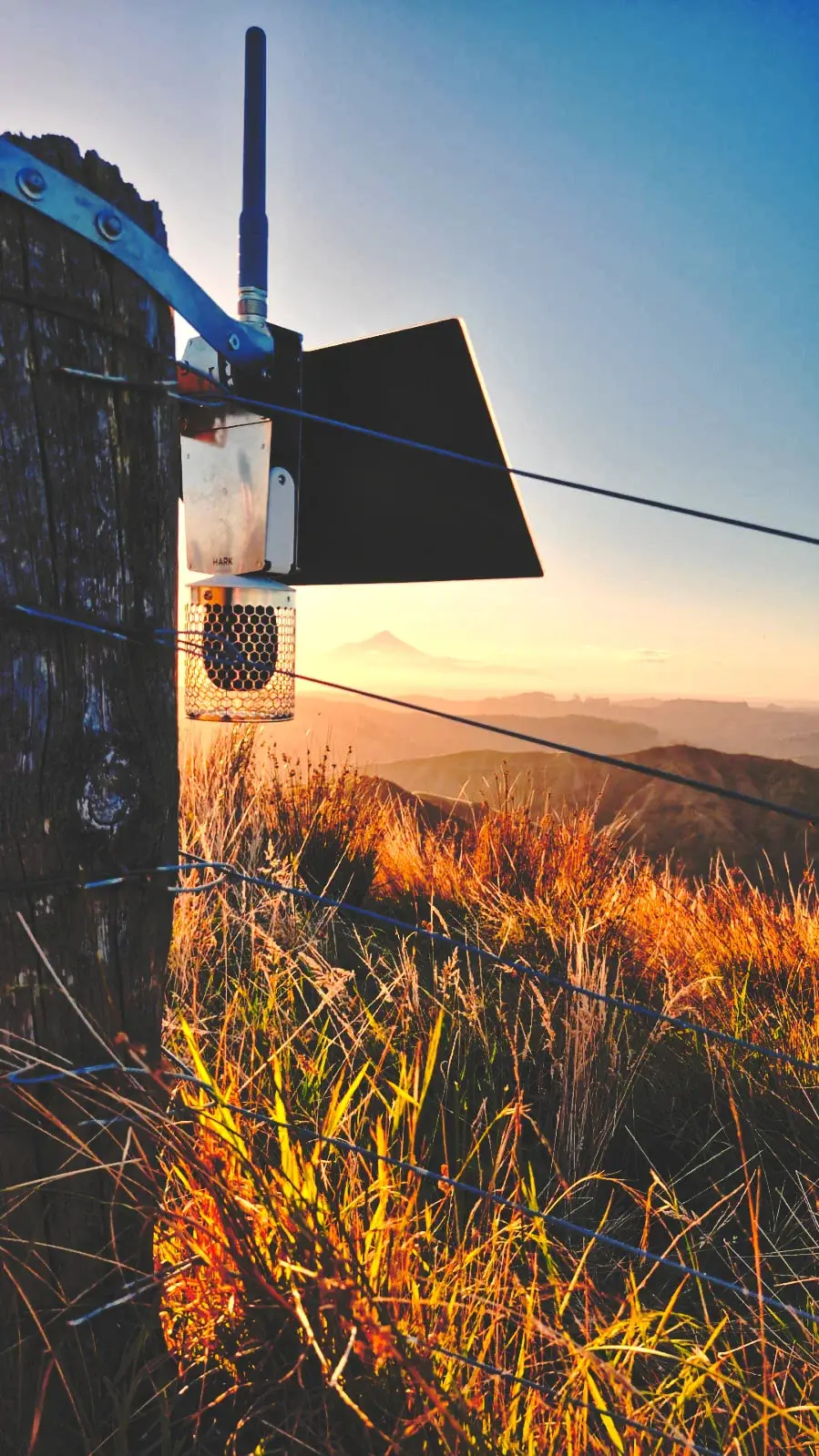
Our forests are speaking. Are you listening?
The world's first acoustic wildlife monitor with true edge AI. While others record and upload to the cloud, HARK runs Google's Perch v2 — a world-class bioacoustic model — directly on-device, on solar power. The AI never needs a signal. When connectivity is available, results — not raw audio — sync to the cloud automatically.
Some of our forests are falling silent.
And we're barely noticing.
In Aotearoa New Zealand, native bird populations are declining while predator numbers rise — unseen, unmeasured, uncontested.
Most of the land is remote, uninhabited, and extremely hard to reach. Traditional monitoring is expensive, infrequent, and produces only a snapshot.
A 5-minute bird count, once or twice a year, is the best data many conservation teams have. That's not enough to save a species.
"How do we give a voice to forests that are too remote, under-resourced, or too expensive to monitor consistently?"
— The question that started Hark
Built for the forest.
Engineered to last.
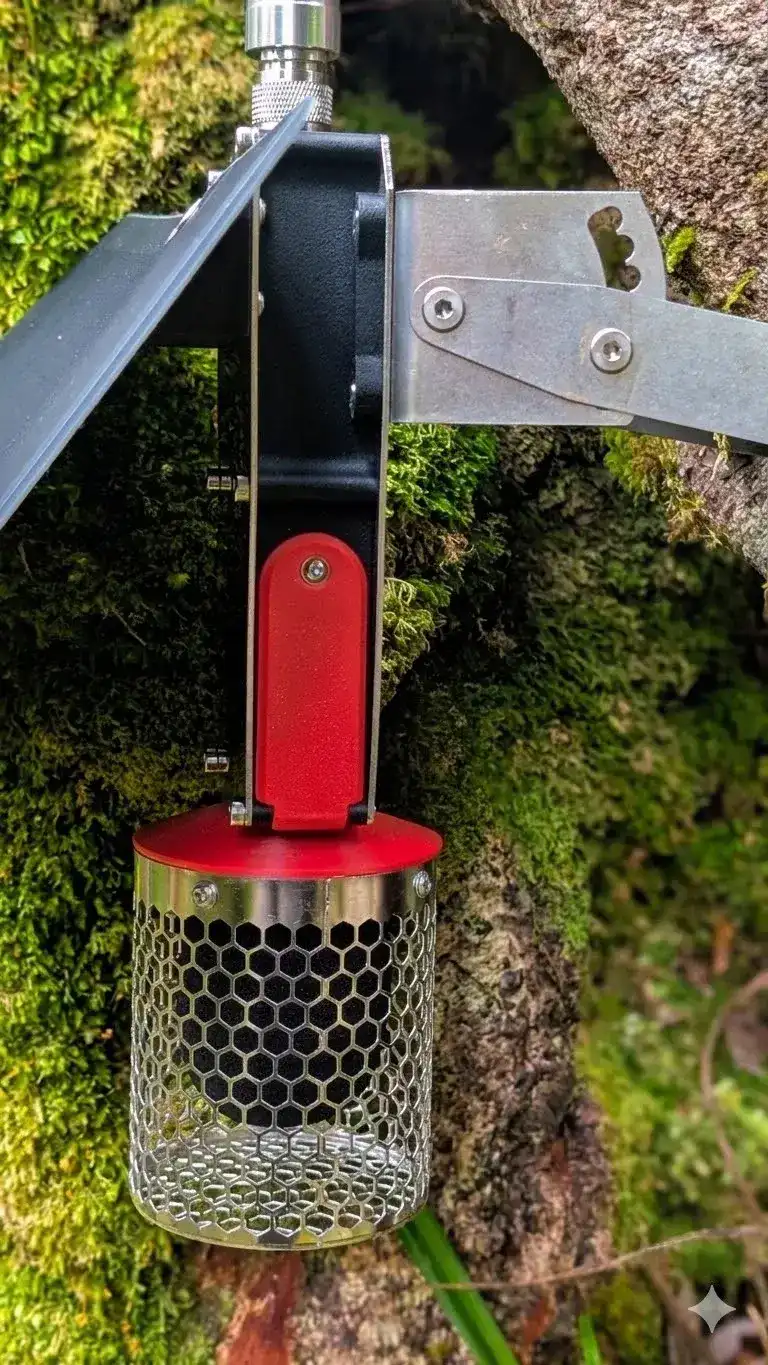
3 microphones. Every direction.
Three analog microphones capture the full acoustic scene simultaneously. Direction detection, triangulation, and up to 192kHz for ultrasonic recording — in hardware built for years of unattended field operation.
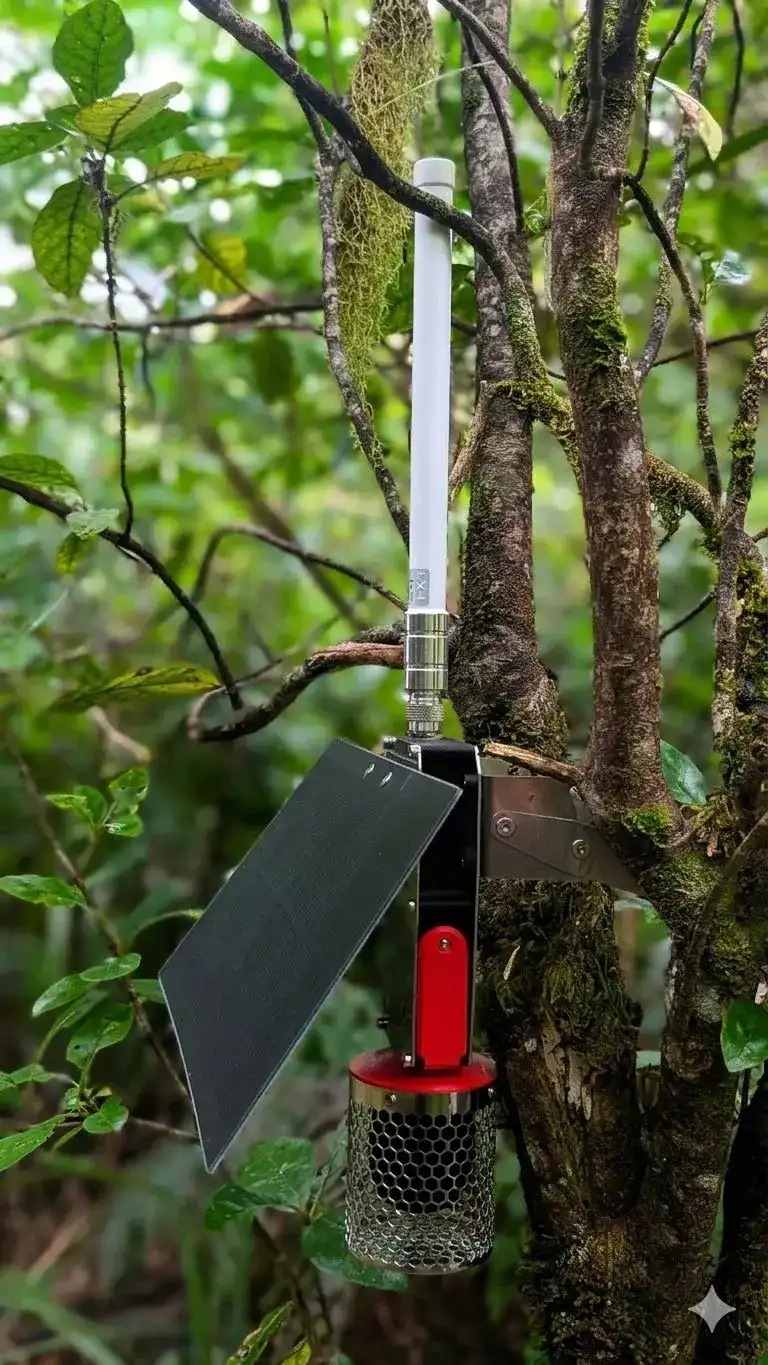
Google's Perch v2. On a solar panel.
The world's most advanced bioacoustic AI model, running fully offline in the deep forest. 100+ species classified simultaneously in real time, with zero connectivity required.
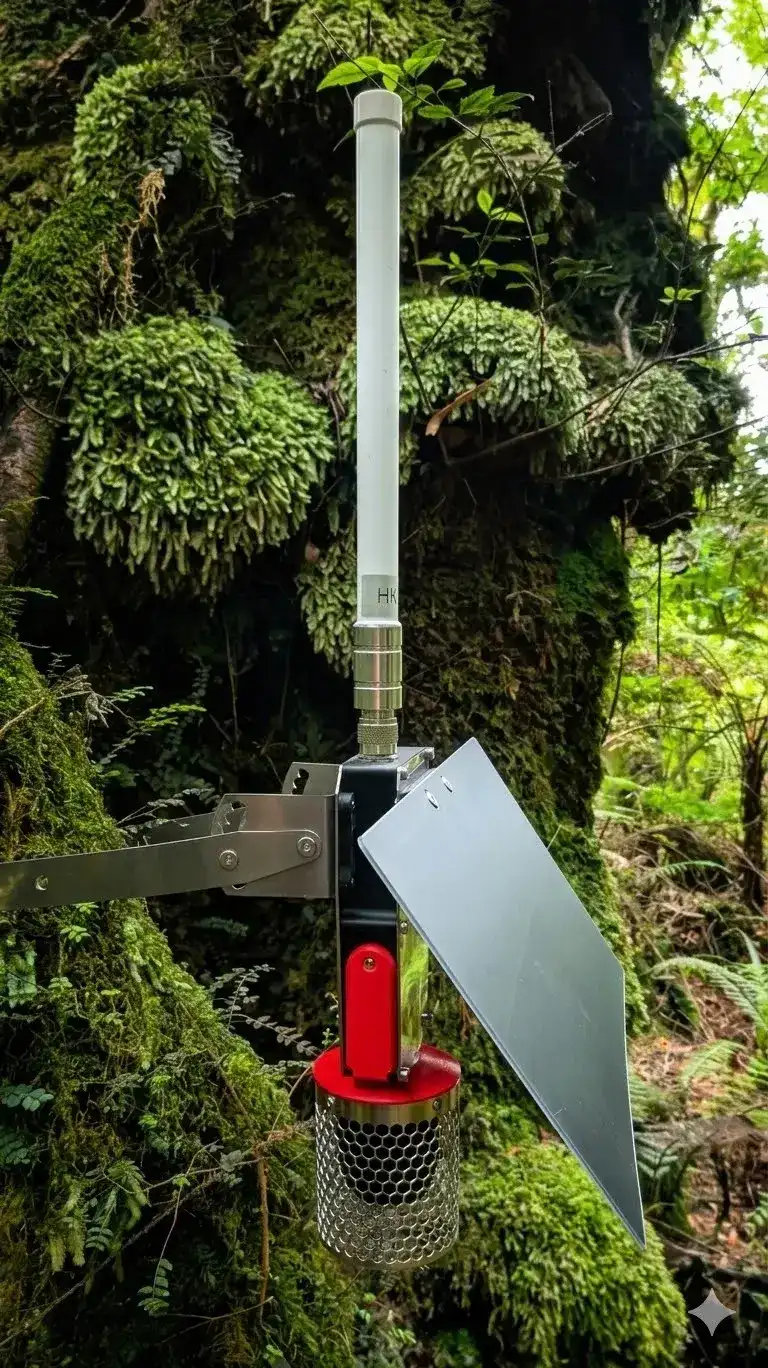
Deploy once. Forget about it.
LiFePO₄ battery with 10-year lifespan. Charges down to −20°C. Stainless steel enclosure, kea-proof, rat-proof, field-hardened. Set it up, walk away, and trust it will still be listening in a decade.
Full specifications
Deploy once.
Monitor forever.
Deploy
Mount a Hark device in your monitoring area. Solar panel, stainless enclosure, done. It self-configures and connects to the cloud.
Listen
Three microphones can listen continuously at up to 192kHz — capturing birds, bats, insects, and ecosystem soundscapes on whatever schedule you remotely set.
Classify
Perch v2 — Google's world-class audio AI — runs in real time on the edge. Run 100+ species simultaneously with minimal power.
Transmit
4G where available. If not, Hark devices form a mesh network — routing data through the forest, valley by valley, until it reaches the cloud.
Understand
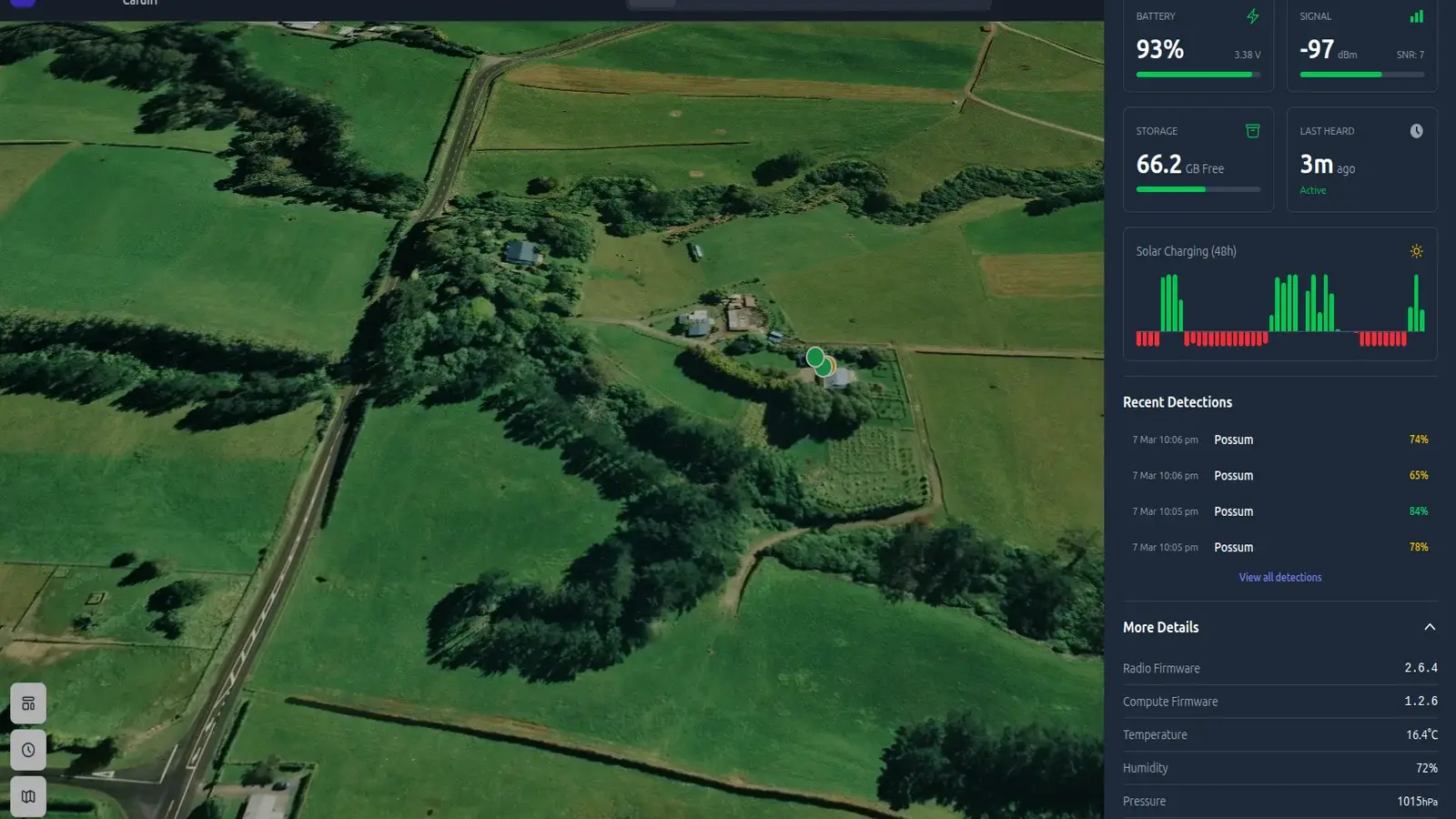
Real-time dashboards show species detections, trends, audio recordings (requestable on demand), and ecosystem health metrics — from anywhere in the world.
Act
Conservation teams receive alerts, spot invasive pests early, verify restoration outcomes, and make faster, better-targeted interventions.
Achieving the impossible.
Running the world's most advanced bird-identification AI on a small solar panel, deep in the New Zealand bush. No mains power. No data centre. Just some cleverly constructed circuit boards, a tonne of low-level optimised firmware — and a healthy dose of Kiwi ingenuity.
Species classified simultaneously in real time
Lines of highly optimised low-level custom firmware & AI code
Max sample rate — capturing birds, bats, insects, and ultrasound
GPS timestamp accuracy via high-spec GNSS + PPS signal
LiFePO₄ battery lifespan, fire safe and charges down to −20°C
FLAC compression possible — lossless audio at a fraction of the size
Built from the ground up.
Multiple custom circuit boards, designed from scratch. Extreme low-level programming to squeeze world-class AI onto hardware that runs on a small solar panel in the deep bush.
Nothing off-the-shelf. No shortcuts. Every component, every circuit, every line of code — built to do more with less, so HARK can run for years without anyone touching it.
Total control.
From anywhere.
A full cloud platform included. No third-party software, no data exports, no waiting. Everything your team needs, live, from your browser.
Nothing else comes close.
HARK is the only purpose-built acoustic wildlife monitor running a world-class AI model on-device, on solar power, in the field.
| Feature | HARK by 800 Trust | AudioMoth Open Acoustic Devices | Song Meter SM4 Wildlife Acoustics | AR5 Alato / DOC standard | BirdWeather PUC BirdWeather | BirdNET-Pi Raspberry Pi (DIY) | Solar-BAR Frontier Labs | BAR-V2 Frontier Labs |
|---|---|---|---|---|---|---|---|---|
| AI & Intelligence | ||||||||
| On-device AI | Limited ¹ | — | — | — | Partial ² | — | — | |
| AI model | Google Perch v2 | TinyML (custom) | Desktop only | — | BirdNET (cloud) | BirdNET v2 | — | — |
| Species simultaneously | 100+ | 1 | — | — | Cloud | — | — | — |
| Works offline | — | |||||||
| Audio | ||||||||
| Microphones | 3 | 1 | 1–2 | 1 | 1 | 1 | 1 | 2 |
| Max sample rate | 192 kHz ³ | 384 kHz | 384 kHz | Unknown | 48 kHz | 48 kHz | 96 kHz | 96 kHz |
| Bit depth | 24-bit | 16-bit | Unknown | Unknown | Unknown | Unknown | Unknown | 16-bit |
| Ultrasonic | BAT model only | Bat mode | — | — | Limited ⁵ | Limited ⁵ | ||
| Audio format | FLAC (lossless) | WAV | WAV | WAV | Compressed | WAV | WAV / FLAC | WAV / FLAC |
| GNSS (GPS) | — | — | — | — | — | — | ||
| Power | ||||||||
| Solar powered | — | — | — | — | DIY only | — | ||
| Rechargeable | — | — | NiMH option | |||||
| Battery chemistry | LiFePO₄ | AA alkaline | D alkaline | AA NiMH/alka. | Li-ion | USB power bank | Built-in | Li-ion / AA alka. |
| Field runtime | Indefinite (solar) | Days–weeks | ~27 days | Up to 28 days | Hours–days | Hours | 18+ months | 600+ hours |
| Active power draw ⁴ | ~116 mW | ~33 mW | ~120 mW est. | ~55–80 mW est. | ~300 mW | ~4,900 mW | ~86 mW | ~84 mW est. |
| Connectivity | ||||||||
| 4G / LTE | — | — | — | — | — | — | — | |
| Mesh networking | — | — | — | — | — | — | — | |
| Cloud dashboard | — | — | — | Local only | — | — | ||
| OTA firmware updates | — | — | — | Manual SSH | — | — | ||
| Data sent to cloud | Results only | — | — | — | Raw audio | Optional | — | — |
| Remote Operations | ||||||||
| Remote audio access | — | — | — | — | — | — | — | |
| Remote schedule control | — | — | — | Limited | — | — | — | |
| Build Quality | ||||||||
| Weatherproof enclosure | Stainless steel | 3rd-party case | IP67 rated | Waterproof | Semi-outdoor | — | ||
| Purpose-built field device | Partial | — | ||||||
¹ AudioMoth supports narrow Edge Impulse TinyML models only (~20 KB RAM limit). Perch-scale multi-species models cannot run on AudioMoth hardware. Source
² BirdNET-Pi runs AI locally on a Raspberry Pi but draws ~980 mA at 5V under CPU load — making sustained solar/battery field deployment impractical. Source
³ HARK hardware supports up to 384 kHz. Current firmware is limited to 192 kHz; 384 kHz recording available on request. Note: 384 kHz requires 16-bit depth and disables on-device AI inference.
⁵ Solar-BAR and BAR-V2 record at up to 96 kHz (48 kHz Nyquist limit) — sufficient for low-frequency bat calls and some echolocation, but below the 96 kHz+ required for full ultrasonic bat survey work.
⁴ All figures in milliwatts (mW = voltage × current) for like-for-like comparison across devices running at different voltages. HARK ~116 mW (35 mA × 3.3 V) includes simultaneous AI inference, 4G radio, SD card write, and FLAC compression. AudioMoth ~33 mW (10 mA × 3.3 V) is recording-only — no AI, no radio, no compression — source. Song Meter SM4 ~120 mW and AR5 ~55–80 mW are estimates derived from published battery capacity and runtime figures (recording only). BirdWeather PUC ~300 mW (60 mA × 5 V) — source. BirdNET-Pi ~4,900 mW (980 mA × 5 V) measured under full CPU load — source. Solar-BAR ~86 mW derived from 12 V × 7.2 Ah ÷ 1,000 h continuous runtime. BAR-V2 ~84 mW estimated from 3.6 V × 14,000 mAh ÷ 600 h — passive recording only, no AI or radio. HARK is the only device in this table running AI inference within its power budget.
Listening to the forest.
Standing beside the people who protect it.
"A forest with high mana is one that is healthy, abundant in birdlife, has strong tree growth, and has rich biodiversity. That is what we are working to restore."
In 2025, alongside Air New Zealand and partners, we planted 28,000 native trees to restore biodiversity corridors across Aotearoa.
We work alongside Ngāti Maru iwi, pairing technology with traditional stewardship. The land remembers who cared for it.
Collaborating with the University of Auckland on population density estimation, direction detection, and biodiversity science.
Backed by the New Zealand Department of Conservation and Predator Free 2050 Ltd — the highest validators in NZ conservation.
Always learning.
Always improving.
Continuously retraining to identify more birds and bats unique to Aotearoa
Ultrasonic detection and species ID for native bat populations
Using HARK's three microphones to determine which direction a call came from — active research with a University of Auckland PhD student
When multiple HARK devices hear the same call, calculate exactly where the caller was using time-of-arrival differences
Automatically detect and flag recordings containing human voices — keeping your wildlife data clean and privacy intact
Custom reports that surface population trends, seasonal patterns, and biodiversity changes over time — turning raw detections into conservation insight
Common questions.
How does HARK compare to AudioMoth, Song Meter, or BirdNET-Pi?
Does HARK really classify species without any internet connection?
How long does HARK last in the field, and how is it powered?
Can I monitor devices and access recordings remotely?
Why can't other devices run AI on solar power in the field?
What species can HARK detect?
How does continuous acoustic monitoring compare to traditional bird counts?
Supported by & partnered with